Rohida Fort: A Logistics Problem Before It Is an Energy Problem
2026-09-17 · 5 min read · Mission URJA — Fort
Rohida Fort: A Logistics Problem Before It Is an Energy Problem
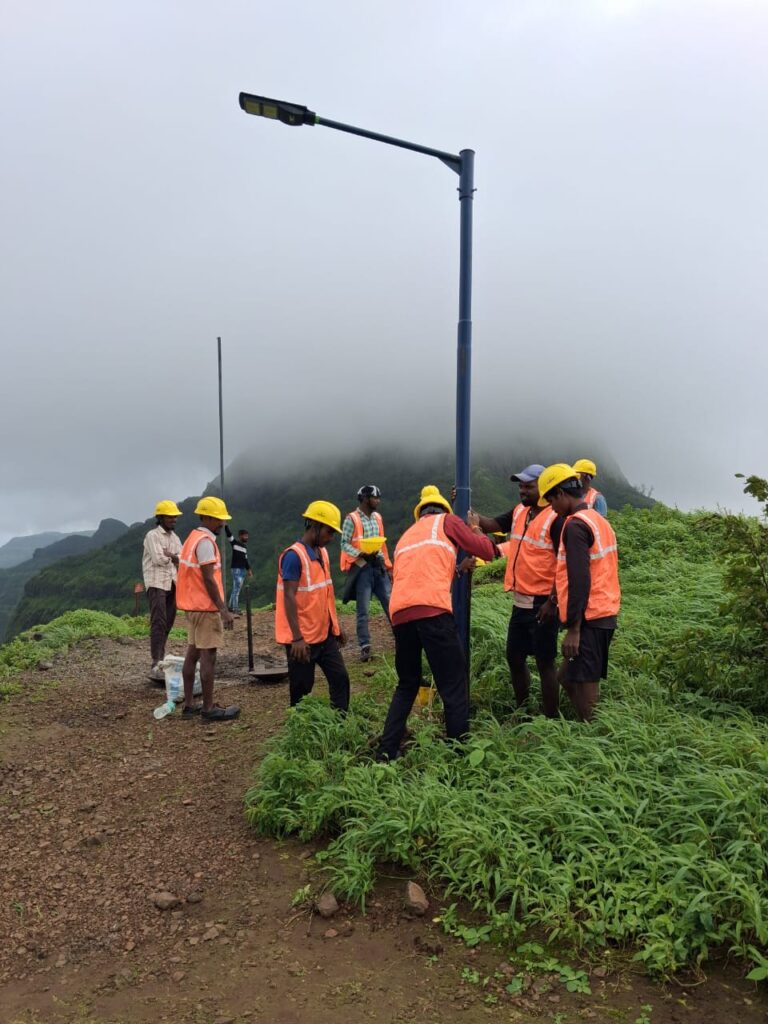
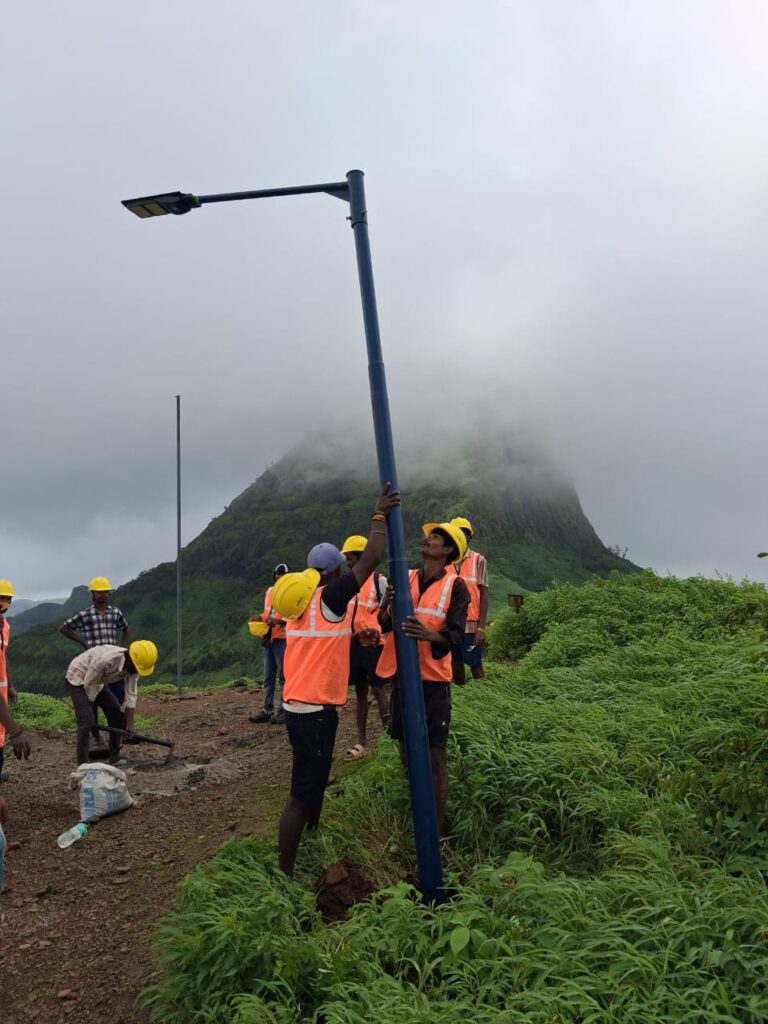
Each pole was erected on terrain where no vehicle could reach.
A fort is a logistics problem before it is an energy problem. That claim sounds abstract until you stand at the base of Rohida Fort in Bhor taluka and look up at the rock-cut steps that are the only route to the summit. No vehicle. No switchback road. Just stone, gradient and gravity.
https://www.youtube.com/watch?v=BW93tJWMKsc
The climb and the switch-on at Rohida.Under Mission URJA, TREEI has lit heritage sites across Maharashtra where grid extension is impractical and diesel impractical for different reasons. Rohida Fort—also known as Vichitragad—presented a challenge that was less about kilowatt-hours and more about kilograms per shoulder. Every solar streetlight pole, every panel, every battery box and every metre of conduit had to be carried up those steps by hand.
The Scene
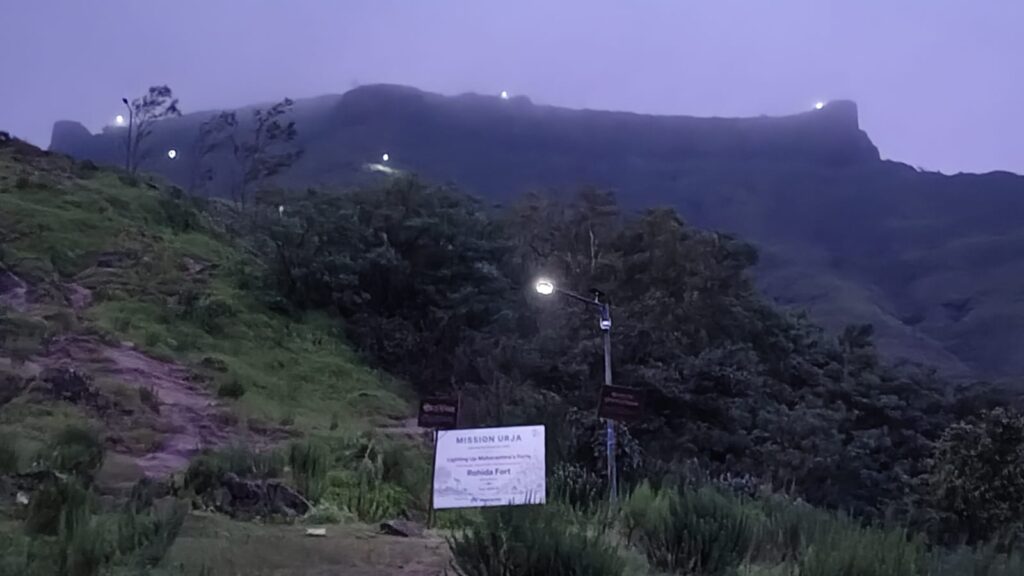
First light at Rohida Fort, Vichitragad, in Bhor taluka.
Rohida sits in Pune district, a ridge fort carved into a landscape of table-topped hills and monsoon green. During the trekking season it draws visitors to its ramparts and water cisterns. After dusk, until now, it returned to darkness. The village below has grid power. The fort, a kilometre above by footpath, does not.The trail begins where the road ends. From there it is stone steps, some intact, some worn to rubble, winding through forest and over exposed rock. In the dry months the path is passable with care. In the monsoon, when TREEI's crew arrived, it was slick, narrow and unforgiving.
What Was at Stake
The monsoon schedule allowed only narrow weather windows for installation.
Heritage sites after dark become exclusion zones. Visitors leave before sunset. Residents, if any remain, navigate by torchlight. The absence of public lighting is not merely inconvenient; it closes the site to evening use, limits safety and signals neglect.For TREEI, the fort represented a proof point. Could the Mission URJA model—community-owned, solar-powered, independently maintained—scale to locations where the installation itself was a feat of coordination? If a village could own and operate a system they did not install themselves, the model held. If not, it was consultancy dressed as capacity-building.
The Day
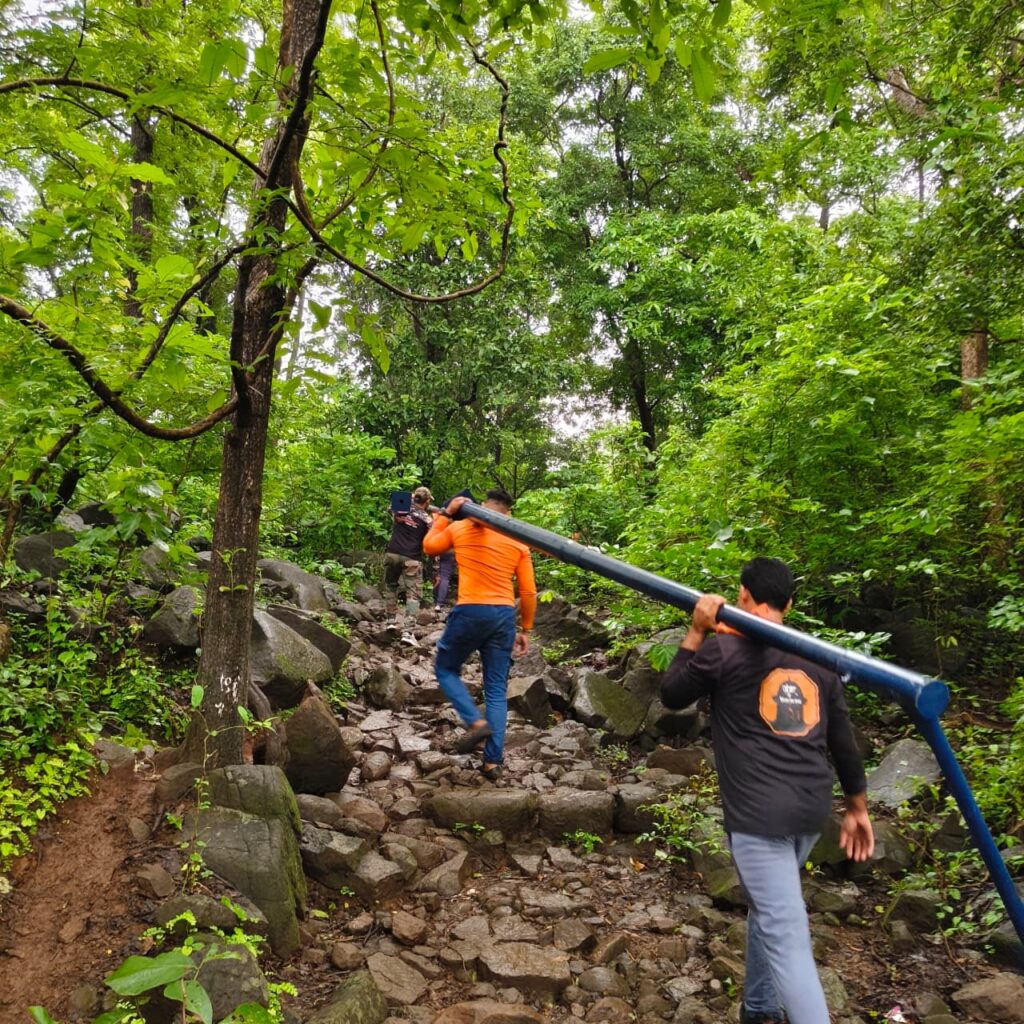
Rock-cut steps are the only access route above the village base.
Installation day began in the village. Poles were staged at the trailhead, each one five metres of galvanised steel, plus fixture, solar panel and wiring. The crew divided into carries: some took poles, others took battery boxes, still others managed the tools and hardware. The ascent was relay work. Carry to a staging point, return for the next load, carry again.The rock-cut steps are uneven. Some sections are wide enough for two abreast; others force single file. Where the trail crosses exposed rock, there is no step at all, only friction and balance. A five-metre pole is not heavy by crane standards, but it is long, awkward and catches the wind. On a staircase with no margin, it becomes a test of coordination.The crew moved in silence, passing loads at choke points, adjusting grips where the path narrowed. Mist rolled in by midday, limiting visibility. The work continued. Each pole had a designated location on the ridge, plotted during the survey. The team worked backwards from summit to base, setting poles downhill so that completed sections were behind them.
A fort is a logistics problem before it is an energy problem.
What It Took
The installation required three days. The first day was transport. The second was foundation work: digging post holes in rock and soil, setting poles plumb, pouring and letting cure. The third was electrical: running conduit, mounting panels, wiring controllers and batteries, testing each light in sequence.No component could be improvised on-site. If a connector failed or a conduit split, the replacement had to come from the base, which meant another climb. The crew carried spares for everything that could break. Even so, two trips were needed to retrieve a replacement panel after one cracked during the carry.By the evening of the third day, the ridge was lit. Dusk arrived, the sensors triggered and the path from village to summit became visible under LED. The installation team stood at the base and watched the lights sequence on. No ceremony, no switch-on event. Just the system, working.
Who Runs It Now
The system is owned by [TO CONFIRM: which body—village panchayat, fort committee, trust?]. TREEI trained [TO CONFIRM: how many people, from where] to manage daily operation and perform basic maintenance: cleaning panels, checking connections, replacing fuses, logging faults. The training covered troubleshooting, not just operation. If a light goes dark, the protocol is to isolate the fault, check the fixture and controller, and escalate only if the problem is beyond the toolkit.The system is designed for a decade of service with minimal intervention. Panels carry a 25-year warranty; batteries are rated for [TO CONFIRM: cycle life]. LED fixtures are sealed against moisture and insects. The village committee holds a maintenance fund seeded during installation. Any repair cost comes from that fund first, ensuring that ownership is financial as well as operational.
The Model
Rohida Fort proves that Mission URJA can extend to locations where installation is the primary barrier. The model does not require vehicle access, grid proximity or flat terrain. It requires planning, staging and a crew willing to carry the work, literally, to the site.Other forts across Maharashtra face identical constraints. Rajgad, Torna, Shivneri—all have trails, all lack lighting, all would benefit from systems that the resident or visiting community can own and operate. The question is not whether the technology works in these settings. It does. The question is whether funders recognise that infrastructure at altitude is infrastructure nonetheless, and that the cost of delivery is part of the cost of access.Ask us what one fort costs.
Thank you for your dedication to TREEI! To keep approvals smooth for the whole team, please submit this between 8:30am to 7pm (Mon–Sat). Requests raised outside these hours are paused — send it again in that window and it'll go right through. Thanks for understanding!
Approval hours (IST) Mon–Sat · 8:30 AM – 7:00 PM Closed · 7:00 PM – 8:30 AM & all day Sunday