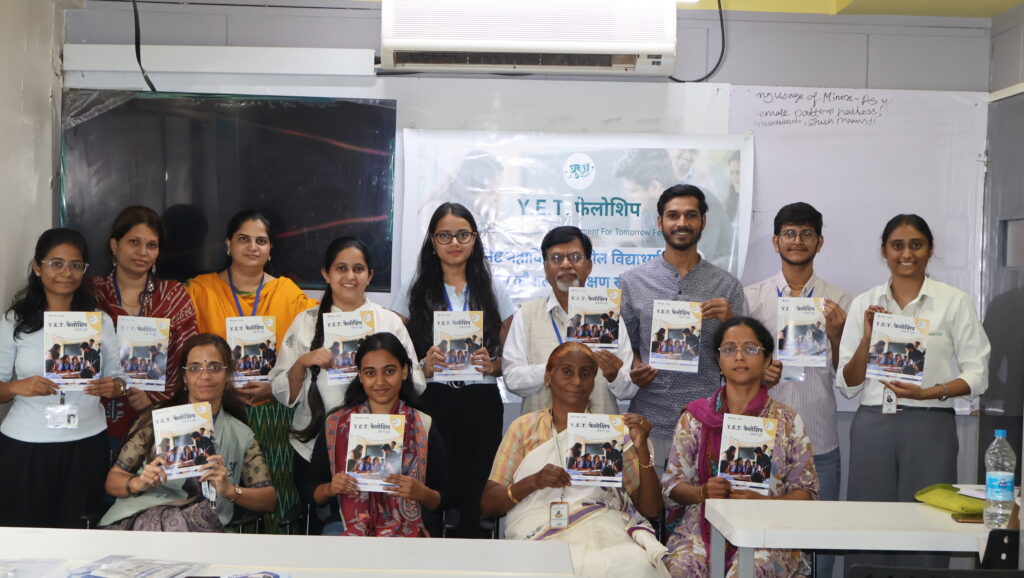
The Y.E.T. Fellowship pilot trains fellows to work across four fields that affect retention in government colleges.
The Y.E.T. Fellowship has launched a pilot in Pune to test whether trained peer mentors can address the reasons students leave government colleges—reasons that have nothing to do with academic ability.The pilot trains a cohort of fellows to work with students across four fields: career guidance, self-recognition, mobile de-addiction and peer influence. These are the gaps that open between a student and their degree—gaps that syllabuses do not close and that lecturers, however committed, rarely have the bandwidth to address.The question the fellowship asks is not whether students can pass. It is whether they can be supported in the specific areas that determine whether they stay long enough to try.
Four fields, one cohort
Fellows are trained in career guidance, self-recognition, mobile de-addiction and peer influence—areas where students need support beyond the curriculum.
Career guidance addresses the fact that many students do not know what their degree can lead to, or how to translate it into employment. Self-recognition builds the capacity to name strengths, weaknesses and goals—skills that are assumed but rarely taught. Mobile de-addiction confronts the distraction that fragments attention and erodes the discipline required to complete a course. Peer influence acknowledges that the company students keep can either anchor them or pull them out.The pilot trains a batch of fellows to work in all four fields with students in government colleges in Pune. The model is peer-to-peer: fellows are close enough in age and experience to be credible, and trained enough to be useful.
A model being tested
This is a pilot. It runs in one city, with one cohort, to establish whether the approach works before it scales. The assumption is that retention is not only an academic problem—it is a structural one, and it requires structured support in the areas that matter most to the students who are deciding whether to stay.
The question the fellowship asks is not whether students can pass. It is whether they can be supported in the specific areas that determine whether they stay long enough to try.
The Y.E.T. Fellowship trains its cohort to work where the need is clearest. If peer guidance can close the gaps that open before a student drops out, it will show in the pilot. If it cannot, the model will be revised. Either way, the question is now being tested in the field.
Thank you for your dedication to TREEI! To keep approvals smooth for the whole team, please submit this between 8:30am to 7pm (Mon–Sat). Requests raised outside these hours are paused — send it again in that window and it'll go right through. Thanks for understanding!
Approval hours (IST) Mon–Sat · 8:30 AM – 7:00 PM Closed · 7:00 PM – 8:30 AM & all day Sunday